Agent KTern.AI as a Service (AKaaS): The Next-Generation Agentic AI for SAP Modernization
In 2017, KTern.AI launched Digital Transformation as a Service (DXaaS) to fundamentally reimagine the business models in enterprise digital transformations with automation delivery offering. This groundbreaking initiative was built upon over 20 years of tribal knowledge intelligence embedded in the platform since the new millennium—a deep reservoir of real-world SAP implementation experience, industry best practices, and transformation patterns accumulated across hundreds of enterprise engagements.
With its Suite First, AI First approach, DXaaS offered comprehensive digital streams to drive value across the end-to-end transformation value chain for enterprises. This business model established a new paradigm where transformation outcomes—not just tools or services—became the deliverable, fundamentally shifting how organizations approached SAP modernization programs.
In 2024, KTern.AI launched Agent KTern.AI as a Service (AKaaS) to fundamentally reimagine the technology models in enterprise AI-first transformations with agent delivery offering. This revolutionary platform becomes supremely effective through its sophisticated knowledge foundation built on two critical data streams.
First, structured data mining systems and SAP knowledge base established since 2017 provide comprehensive technical documentation, configuration patterns, and best practices across all SAP modules and landscapes. Second, unstructured data captured since the 2000s—including real-world implementation documentation, custom code repositories, incident resolution histories, and lessons learned from hundreds of transformation programs—has been successfully loaded and pretrained into its agentic AI system.
This dual-source intelligence is specifically focused on SAP R/3, SAP ECC, SAP S/4HANA, and SAP Cloud ERP transitions in line with RISE with SAP and Grow with SAP methodologies, tailored to address specific business needs in SAP transformation and modernization.
The Evolution: From DXaaS to AKaaS
Understanding the Progression
KTern.AI's journey represents a deliberate evolution in enterprise transformation methodology:
DXaaS (Digital Transformation as a Service)
The foundational business model that established KTern.AI's approach to SAP modernization. DXaaS focused on delivering transformation outcomes through structured methodologies, governance frameworks, and process re-engineering. This model addressed the "what" and "why" of transformation—defining business objectives, compliance requirements, and strategic outcomes.
AKaaS (Agent KTern.AI as a Service)
The technology model that operationalizes fully autonomous agentic AI. While DXaaS augmented human capabilities, AKaaS fundamentally shifts the paradigm by deploying self-directed agents capable of independent reasoning, decision-making, and execution. AKaaS addresses the "how" of transformation-autonomously executing complex workflows from data mining through implementation with minimal human intervention.
The Complementary Architecture
These two models don't replace each other; they form an integrated ecosystem:
| Model | Layer | Primary Focus | Key Capability |
|---|---|---|---|
| DXaaS | Business Strategy | Transformation outcomes and governance | Strategic alignment and compliance frameworks |
| AKaaS | Technology Foundation | Autonomous agent operations | Self-directed analytical and transformation tasks |
This layered approach ensures enterprises benefit from strategic clarity (DXaaS), and autonomous execution (AKaaS) simultaneously.
Why Agentic AI Represents the Next Frontier
Traditional AI systems, including those in DXaaS, operate reactively—responding to prompts and executing predefined workflows. Agentic AI systems in AKaaS operate proactively-setting objectives, planning multi-step strategies, adapting to changing conditions, and learning from outcomes without constant human direction.
This distinction is critical for SAP modernization because:
- Complexity Management: SAP landscapes involve thousands of interconnected processes, customizations, and integrations that exceed human analytical capacity
- Dynamic Environments: Enterprise systems evolve continuously; agents can monitor, analyze, and respond to changes in real-time
- Knowledge Retention: Agent memory systems preserve institutional knowledge that would otherwise be lost during consultant transitions
- Scale Economics: Agents can perform analysis across hundreds of systems simultaneously, something impossible with human-only approaches
Agent KTern.AI as a Service (AKaaS): Architecture and Innovation
Foundational Principles
AKaaS operates on four foundational principles that distinguish it from earlier generations:
Autonomous Goal Achievement
Agents receive high-level objectives ("Assess readiness for S/4HANA migration") and independently determine the optimal sequence of analyses, data collection, and reporting required to achieve that goal.
Adaptive Planning
Agents continuously revise their approach based on intermediate findings. If an agent discovers unexpected customizations during analysis, it automatically adjusts its assessment strategy without human intervention.
Collaborative Specialization
Rather than monolithic AI systems, AKaaS deploys specialized agents that excel at specific tasks (process mining, code analysis, documentation generation) and coordinate through agent-to-agent protocols.
Continuous Learning
Every agent interaction contributes to the collective intelligence of the system. Insights gained from one enterprise's transformation inform recommendations for subsequent projects.
The Enterprise Knowledge Foundation
AKaaS's effectiveness stems from KTern.AI's proprietary enterprise knowledge graph:
Structured Knowledge Base (2017-Present)
- Comprehensive SAP module documentation (FI, CO, MM, SD, PP, etc.)
- Configuration parameter databases for ECC and S/4HANA
- Best practice libraries for RISE with SAP and Grow with SAP
- Integration patterns for SAP BTP, Fiori, and Cloud ERP
- Compliance frameworks (SOX, GDPR, industry-specific regulations)
Unstructured Data Archive (Early 2000s-Present)
- Real-world implementation documentation from hundreds of projects
- Incident and problem resolution histories
- Custom code repositories and modification patterns
- Lessons learned databases from transformation programs
- Industry-specific process variations and optimizations
This dual-source knowledge base, accumulated over two decades, provides agents with context that generic AI models simply cannot match.
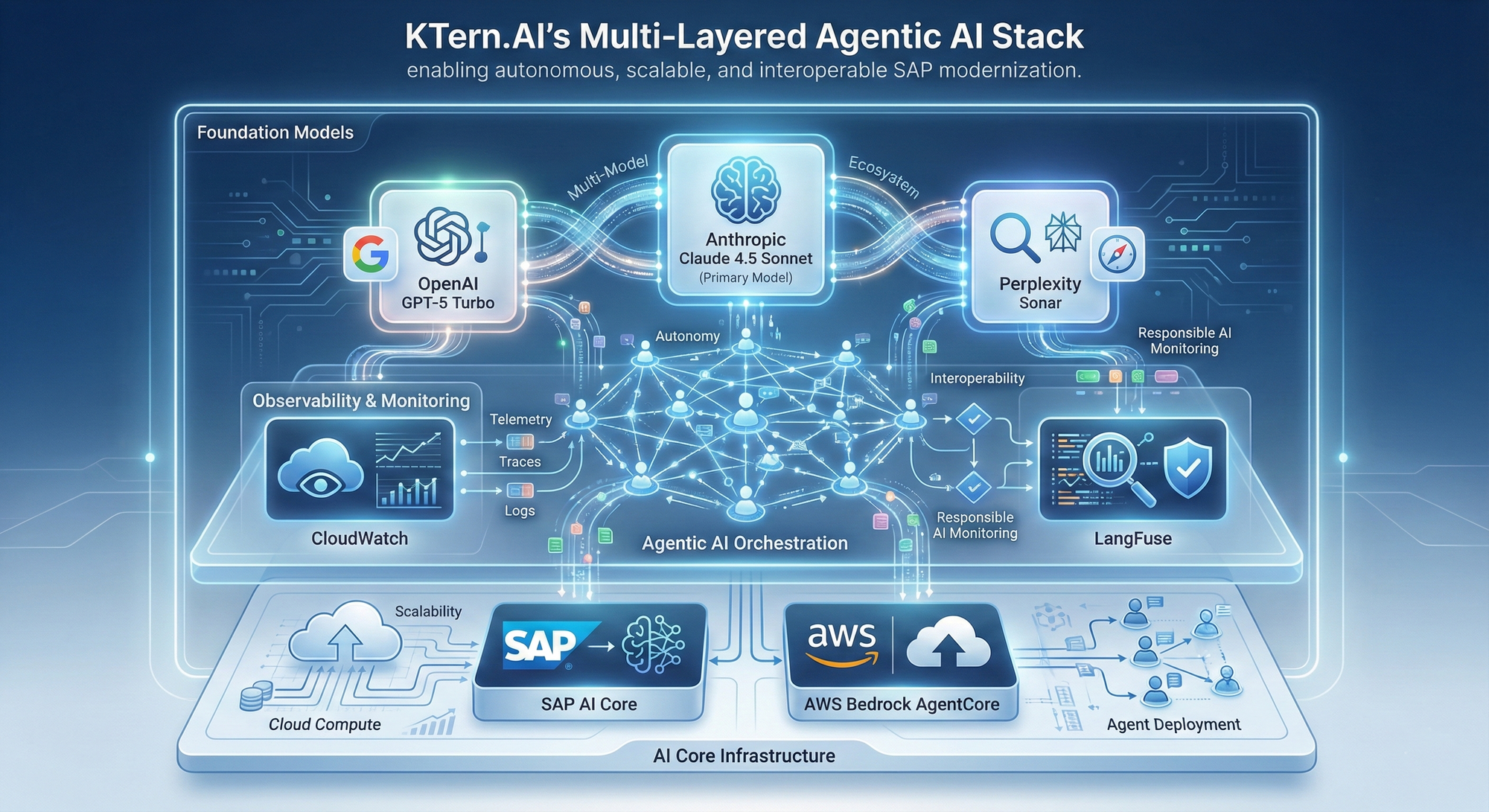
The Multi-Layered Agentic AI Stack
Infrastructure Layer
SAP AI Core Integration
Native deployment on SAP's AI Core platform ensures:
- Seamless access to SAP system data through secure connectors
- Compliance with SAP's security and privacy standards
- Optimized performance within SAP landscapes
- Integration with SAP BTP services and capabilities
AWS Bedrock AgentCore
Provides enterprise-grade agent orchestration through:
- Scalable compute resources for parallel agent operations
- Advanced memory management for long-running workflows
- Security isolation between agents and enterprise systems
- Cost optimization through dynamic resource allocation
Observability and Governance Layer
CloudWatch Monitoring
Real-time tracking of:
- Agent resource consumption and performance metrics
- Workflow completion rates and failure points
- Data access patterns and API call volumes
- Cost allocation across different transformation activities
LangFuse Telemetry
Detailed visibility into:
- Individual agent reasoning processes and decision trees
- Quality metrics for generated documentation and recommendations
- User interaction patterns and satisfaction indicators
- Model performance degradation signals for proactive maintenance
Foundation Model Ecosystem
AKaaS employs a sophisticated multi-model approach optimized for different task requirements:
Primary: Anthropic Claude Sonnet 4.5
Chosen for:
- Superior reasoning capabilities for complex SAP scenarios
- Excellent instruction-following for structured enterprise tasks
- Strong context retention across long analytical workflows
- High-quality technical documentation generation
- Robust safety guardrails aligned with enterprise compliance
Use cases: Fit-gap analysis, business process documentation, strategic recommendation generation, compliance report creation
Secondary: OpenAI GPT-5 Turbo
Deployed for:
- Rapid response for real-time queries
- Creative problem-solving for novel transformation challenges
- Multi-language support for global implementations
- Code generation and ABAP analysis
Use cases: Custom code modernization, user interface improvements, quick technical queries
Tertiary: Perplexity Sonar
Utilized for:
- Real-time search across SAP documentation and community resources
- Fact verification for compliance and regulatory requirements
- Trend analysis from SAP community discussions and updates
- External benchmark data for performance comparisons
Use cases: Latest SAP release information, industry benchmarking, regulatory updates
This multi-model architecture ensures each task is executed by the most appropriate AI system, optimizing both quality and cost.
KTern.AI Jupiter R1: The Breakthrough Small Language Model
The Challenge of Enterprise-Scale SAP Data
SAP systems generate massive data volumes that create specific challenges for AI analysis:
- Volume: Large enterprises may have millions of custom code lines, thousands of configuration tables, and decades of transaction history
- Complexity: Interdependencies between modules, custom enhancements, and third-party integrations create intricate relationship networks
- Context Requirements: Understanding a single configuration often requires knowledge of related settings across multiple modules
- Latency Sensitivity: Transformation decisions require rapid analysis to maintain project momentum
- Cost Constraints: Processing massive datasets through large language models becomes prohibitively expensive at scale
Jupiter R1 Architecture and Capabilities
KTern.AI developed Jupiter R1 specifically to address these challenges:
Optimization for SAP Metadata
Jupiter R1 was trained exclusively on SAP-specific data structures:
- Table schemas and relationships for all major SAP modules
- Configuration parameter patterns and dependencies
- Custom code syntax and common modification patterns
- Integration standards and API specifications
This specialization allows Jupiter R1 to achieve superior accuracy on SAP tasks compared to general-purpose models, despite its smaller size.
Performance Characteristics
- Inference Speed: 10-50x faster than large foundation models for SAP-specific tasks
- Cost Efficiency: 90% lower processing costs for equivalent SAP analytical workloads
- Context Window: Optimized 32K token window specifically designed for typical SAP configuration and code analysis tasks
- Accuracy: Matches or exceeds larger models on SAP domain-specific evaluations
Supported SAP Landscapes
Jupiter R1 provides comprehensive coverage across:
- SAP ECC 6.0: All modules including FI, CO, MM, SD, PP, PM, QM, PS, HR
- SAP S/4HANA: On-premise, Cloud, and hybrid deployments
- SAP BW/4HANA: Data warehousing and analytics configurations
- SAP CRM: Customer relationship management customizations
- SAP SRM: Supplier relationship management processes
- SAP IBP: Integrated business planning scenarios
- SAP APO: Advanced planning and optimization
- SAP HCM/SuccessFactors: Human capital management transitions
- SAP Ariba: Procurement and supply chain integration
- SAP Concur: Travel and expense management
Integration with SAP-RPT1 Simulation Model
Jupiter R1 powers KTern.AI's proprietary SAP-RPT1 (SAP Rapid Process Testing 1) simulation framework:
Pre-Migration Simulation
Before physical system changes, SAP-RPT1 creates digital twins of business processes:
- Simulates how existing processes will behave in S/4HANA
- Identifies potential breaks in custom code or integrations
- Predicts performance changes under new architecture
- Models user experience impacts from UI changes
Risk Assessment
Quantifies transformation risks through:
- Probability analysis of migration issues based on historical data
- Impact scoring for critical business processes
- Dependency mapping showing cascading failure risks
- Mitigation recommendation generation
Optimization Opportunities
Identifies enhancement possibilities:
- Processes that could be standardized to reduce customization
- Integration patterns that could leverage modern SAP BTP services
- Manual workflows that could be automated with Fiori apps
- Performance bottlenecks addressable through S/4HANA features
Agent Orchestration: Intelligence in Motion
Unlike static AI applications, KTern.AI’s agents operate within a distributed orchestration framework designed to support both autonomous and human-assisted workflows.
This orchestration is driven by three key frameworks:
- Strands: Workflow chaining framework for connecting sequential SAP modernization tasks.
- LangChain & Microsoft Autogen: Interoperable libraries for agent communication and reasoning in context-rich pipelines.
- Proprietary MCP Servers: For secure, isolated, high-speed agent task execution in network-segmented enterprise environments.
Each agent in AKaaS interacts through A2A (Agent-to-Agent) protocol, enabling multiple specialized agents to operate collaboratively across:
- Fit-gap automation.
- WRICEF object documentation.
- Upgrade assessment.
- Change impact simulations.
- Control and compliance audits.
Agents also utilize LangMem (Long-term Agent Memory) and AgentCore Memory to learn from enterprise patterns, adapt to user behavior, and personalize outputs — mimicking human consultants while maintaining computational precision.
Responsible AI and Observability
As AI systems assume higher autonomy, maintaining transparency, accountability, and ethical standards becomes crucial. KTern.AI integrates Responsible AI principles within its AKaaS architecture through:
- LangFuse Telemetry: Provides real-time visibility into agent actions and decisions.
- AgentCore CloudWatch: Tracks agent performance, failures, and data flows for auditability.
- Evals and Traces: Continuously measure accuracy, latency, and bias to ensure output aligns with SAP best practices.
This observability not only builds enterprise trust but also facilitates AI governance, enabling organizations to continuously evaluate system integrity, security, and fairness.
Real-World Applications: SAP Analytics to Modernization
Agent KTern.AI plays multiple high-value roles across the SAP lifecycle — from analytics to modernization. Some of the key applications include:
- Business Process Mining and Simulation:
Automated discovery, mapping, and simulation of current SAP landscapes to forecast transformation outcomes. - Fit-to-Standard and Delta Analysis:
Autonomous documentation and compatibility assessments between ECC and S/4HANA. - WRICEF Acceleration:
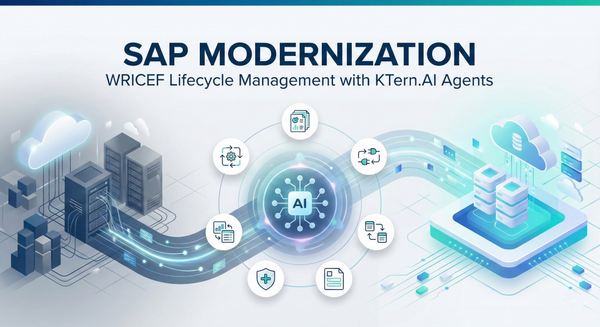
Automated identification and documentation of WRICEF objects, saving weeks of manual effort. - Change and Impact Analytics:
Real-time impact reports on SAP upgrades, configuration changes, or data migrations. - Compliance and Governance Analytics:
Generation of audit trails, configuration logs, and policy adherence checklists.
Each use case leverages Agent Swarms — clusters of interoperable agents — to analyze, simulate, and optimize specific business processes with human-in-the-loop interaction for validation.
Human + AI Collaboration: The Multiplier Effect
The promise of AKaaS extends beyond automation; it’s about symbiotic collaboration. The model is best captured in the formula:
Add KTern.AI Agents + SAP Humans = Multiply Productivity × Efficiency
By offloading repetitive or complex analytical tasks to autonomous agents, SAP consultants and business teams can focus on higher-value activities — strategy, creativity, and innovation.
This co-pilot relationship strengthens human intelligence rather than replacing it. The agents act as augmentation tools, continuously learning from user preferences and enterprise context — leading to compounding improvements in decision velocity, accuracy, and cost efficiency.
Scalability and Interoperability in Enterprise Environments
AKaaS is architected for scale and adaptability, enabling seamless integration across enterprise technology stacks. Its distributed architecture supports:
- Scalable Agent Deployments: Horizontally distributed agent runs across large data clusters.
- Network Isolation: Ensures security and compliance in multi-tenant enterprise systems.
- Agent Swarm Collaboration: Enables multi-agent workflows with cross-domain intelligence sharing.
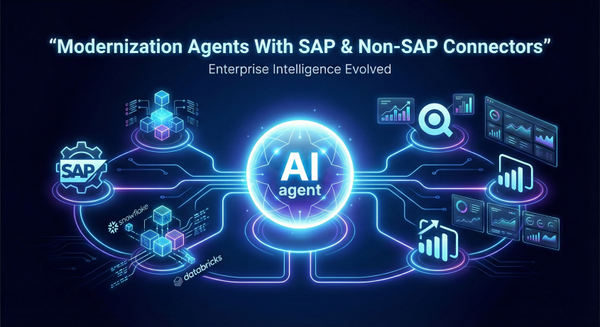
- Native Tool Interoperability: Easily connects with SAP Fiori, Solution Manager, Jira, Confluence, and enterprise-grade analytics tools.
This flexibility means organizations can integrate agent capabilities within existing systems without extensive reconfiguration, accelerating time-to-value during transformation programs.
Why AKaaS Matters for the Future of Analytics
Analytical transformation is no longer about dashboards and BI tools — it’s about autonomous reasoning, contextual awareness, and continuous learning.
Agent KTern.AI as a Service stands at the intersection of analytics, automation, and intelligence. It transforms analytics from a passive reporting function into an active agent-based intelligence layer, capable of interpreting, diagnosing, and recommending actions based on SAP data.
For enterprises pursuing RISE with SAP or Grow with SAP, AKaaS enables:
- Faster time-to-insight through AI-powered data simulation.
- Reduced transformation costs via automation of technical assessments.
- Improved compliance and governance through AI-driven documentation.
- Continuous modernization supported by agent observability and retraining.
The Road Ahead: Continuous Innovation in Enterprise AI
KTern.AI continues to advance its R&D in agentic architectures, aiming to refine Jupiter R1 and extend AKaaS into newer domains like:
- SAP Sustainability and Green Ledger Analytics.
- AI-Driven Supply Chain Optimization.
- Predictive Cloud ERP Migration Planning.
- Autonomous SAP Testing and Validation.
Each innovation contributes to KTern.AI’s ultimate goal — to evolve from AI assistance to full agent autonomy, enabling enterprises to run self-managing SAP ecosystems.
Conclusion: Reimagining SAP Analytics with Agentic Intelligence
Agent KTern.AI as a Service (AKaaS) is more than a technical innovation — it’s a paradigm shift. It represents the convergence of three enterprise imperatives: automation, intelligence, and interoperability.
With its layered agentic architecture, proprietary small language models, and robust observability frameworks, AKaaS empowers enterprises to accelerate SAP modernization, enhance analytics capability, and embrace AI-first transformation at scale.
As enterprises continue to evolve toward intelligent operations, KTern.AI’s agent ecosystem provides the foundation for a future where human expertise and AI agents collaborate seamlessly — transforming analytics, decision-making, and modernization into a single, continuous, and intelligent process.
For more information or to explore how KTern.AI can transform your SAP testing, contact us at info@ktern.com