Jupiter R1-Powered KTern.AI Agents for SAP
KTern.AI is building a network of SAP-specialized AI agents—powered by its in-house Jupiter R1 small language model (SLM)—to automate some of the most painful, manual parts of SAP work: exception handling, WRICEF documentation, test case design, and clean-core-friendly code generation. These agents are designed to work alongside SAP consultants and business users, turning tribal knowledge and repetitive tasks into reliable, autonomous workflows.
Why KTern.AI Bets On Agents
Most SAP teams still manage exceptions, custom code, testing, and documentation through spreadsheets, emails, and manual effort, which leads to slow transformation, high risk, and burnout for project teams. KTern.AI’s vision is to move from tool-based automation to an “agentic” model—specialized AI agents that can monitor SAP systems, reason over context, and take actions or generate artifacts with minimal human intervention.
Instead of generic AI that needs constant prompting, each KTern.AI agent is built around a clear SAP job-to-be-done: fix exceptions, document WRICEFs, generate test cases, or guide clean and scalable extensions. This makes them easier to adopt in real projects and aligns their outputs with SAP governance, audit, and clean-core requirements.
Jupiter R1: The Agent Core
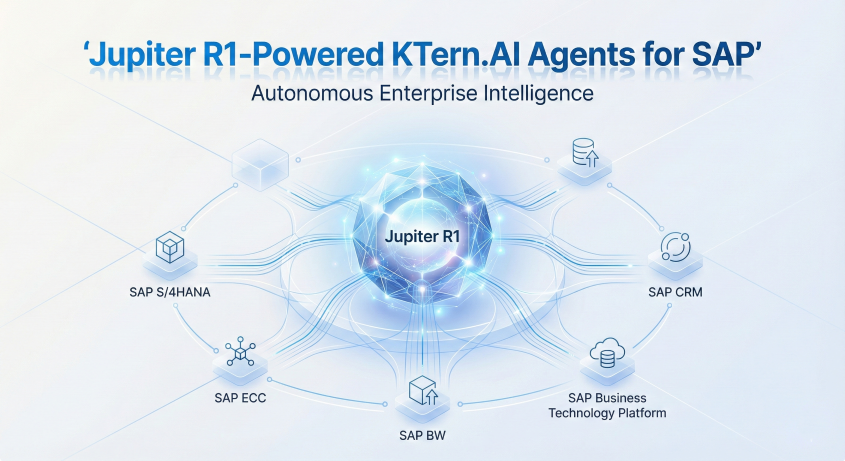
At the center of this agent ecosystem is Jupiter R1, KTern.AI’s SAP-specific small language model, trained on SAP processes, WRICEF patterns, error codes, and testing structures. Unlike generic LLMs, Jupiter R1 is optimized for SAP semantics—T-Codes, configuration, ABAP syntax, and typical exception patterns—so it can interpret system data and project artifacts the way an experienced SAP consultant would.
KTern.AI pairs Jupiter R1 with larger foundation models from vendors like Anthropic, OpenAI, and Perplexity, but keeps Jupiter R1 as the “brain” for SAP-heavy reasoning and context handling. This hybrid approach helps overcome context limits, latency, and data-size constraints while keeping costs predictable and responses more deterministic for enterprise landscapes.
How The Agentic Architecture Works
KTern.AI structures its agents around a repeatable loop of detection, analysis, recommendation, and execution, orchestrated by Jupiter R1.
- Detection: Agents continuously scan logs, WRICEF inventories, process traces, or development artifacts to identify exceptions, gaps, or documentation needs.
- Analysis: Jupiter R1 interprets SAP data, correlates it with business processes, and prioritizes what matters using domain-specific reasoning.
- Recommendation: The agent proposes test cases, remediation actions, documentation drafts, or code refactoring options aligned to clean-core and compliance guidelines.
- Execution: In many scenarios, agents can trigger workflows, generate full documents, or drive automation tools, while still keeping humans in control for approvals and policies.
This design makes KTern.AI’s agents not just chat interfaces but operational components that can plug into SAP landscapes and COEs as always-on digital team members.
SAP Exception Handling Agent
The SAP Exception Handling Agent is built to end the firefighting culture around blocked invoices, failed IDocs, job dumps, and reconciliation errors. Instead of waiting for period-end crises or user complaints, the agent continuously monitors FI, MM, SD, and integration layers to spot anomalies as they occur.
Using Jupiter R1, the agent performs root-cause analysis across tables, configuration, and custom logic, translating technical issues into financial, operational, and compliance impact. It then provides guided or automated remediation steps with relevant T-Codes, sequence of actions, and potential automation opportunities so the same exception doesn’t recur.
Business Impact Of Exception Automation
By converting exception handling into an autonomous loop, enterprises can reduce revenue leakage, avoid compliance surprises, and stabilize closing cycles. The agent also feeds insights into clean-core and modernization programs, highlighting which recurring exceptions are symptoms of technical debt or legacy customizations.
For SAP COEs, this shifts the team from reactive ticket resolution to proactive, policy-driven operations, with humans supervising the agent network instead of manually chasing every error.
WRICEF Documentation Agent
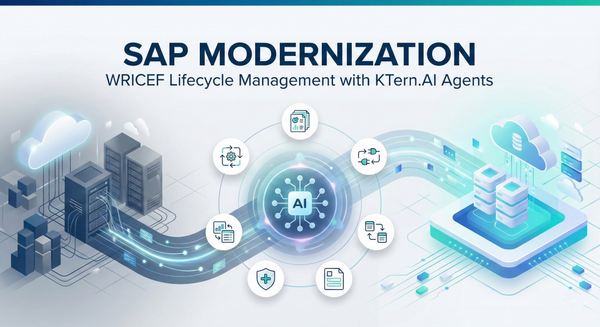
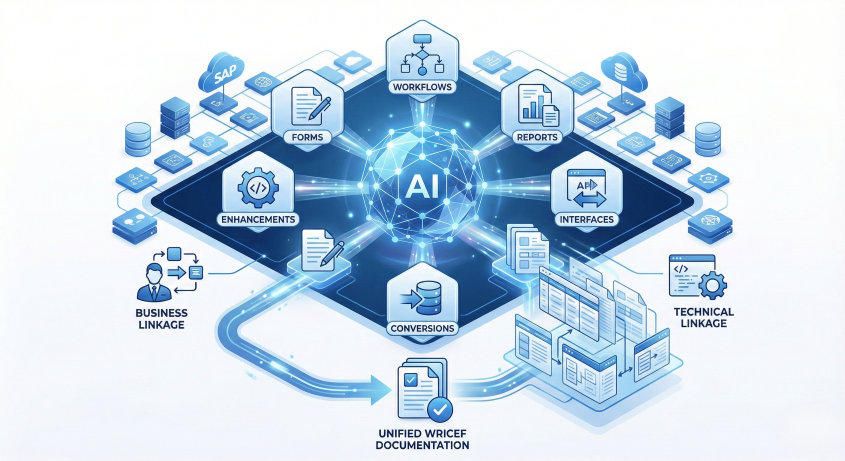
The WRICEF Documentation Agent focuses on one of the most under-appreciated but critical areas in SAP: documenting custom objects (Workflows, Reports, Interfaces, Conversions, Enhancements, and Forms). In large ECC or S/4HANA systems, manual documentation of hundreds of WRICEF objects can easily consume thousands of person-days and still end up incomplete or inconsistent.
KTern.AI’s agent connects to the SAP system, builds a complete inventory of WRICEF objects, analyzes their usage, and auto-generates structured documentation that links technical objects back to business processes. The output is designed for both functional and technical audiences, with clear sections for business purpose, dependencies, data flows, and technical design details.
Effort Savings And Migration Readiness
In benchmark scenarios, moving from manual WRICEF documentation to KTern.AI’s automated approach can reduce effort by roughly three quarters for large landscapes. That efficiency gain not only saves cost but also unlocks better migration planning for S/4HANA and cloud by giving teams a reliable, always-current view of their custom footprint.
Because the agent runs on top of Jupiter R1 and KTern.AI’s Digital Maps, it can keep documentation alive—updated as systems evolve—rather than treating it as a one-time project artifact that quickly becomes obsolete.
Test Case Generation Agent
Traditional SAP testing relies heavily on tribal knowledge and manual test design, which makes it slow, inconsistent, and hard to scale across WRICEF-heavy environments. KTern.AI’s Test Case Generation Agent changes this by auto-generating complete, audit-ready test cases directly from WRICEF documents and process insights.
The agent uses Jupiter R1, trained on thousands of SAP process models, functional specs, and test structures, to derive test conditions, steps, data needs, and expected results that align with real-world business flows. It can do this across ECC, S/4HANA, BW, CRM, SRM, and other SAP systems, and combines SAP-specific models like RPT1 with Jupiter R1 for deeper coverage.
Faster, Smarter SAP Testing
For SAP testing teams, this means a drastic reduction in the time needed to prepare test suites while improving consistency and coverage across WRICEF objects. Because test cases are generated from the same source artifacts the agents already understand (documents, logs, and process traces), they remain aligned with actual system behaviour instead of being purely theoretical.
Over time, this lays the foundation for more autonomous regression testing, impact analysis, and risk-based prioritization, with Jupiter R1 acting as the reasoning layer across test assets.
Code Generation And Clean-Core Extension
KTern.AI also extends its agentic approach into the development space with code-centric agents (for example, the CodeGenie experience in Digital Clean Core) that guide customers and partners toward side-by-side, clean-core-friendly extensions. These agents can assist with template generation, boilerplate code, and design patterns that align with SAP BTP and extensibility best practices instead of hard-coding logic inside the core.
By combining code suggestions with impact analysis and exception insights, the agents help teams gradually reduce technical debt while building new capabilities in a more governed, reusable way. This supports SAP’s clean core strategy and makes future upgrades, S/4HANA conversions, and cloud moves more predictable.
How The Agents Complement Each Other
Each KTern.AI agent can be used independently, but the real value emerges when they work together on the same SAP landscape. For example:
- The WRICEF Documentation Agent builds a single source of truth for custom objects.
- The Test Case Generation Agent uses that documentation to create robust test cases.
- The Exception Handling Agent monitors how those objects behave in production and feeds exceptions back into documentation, testing, and modernization priorities.
All of this is grounded in Jupiter R1’s domain-specific understanding, allowing the platform to reason across documents, logs, and configuration rather than treating each artifact in isolation.
KTern.AI Agents At A Glance
From Tools To An Autonomous SAP Operating System
KTern.AI’s agent ecosystem, anchored by Jupiter R1, is moving SAP landscapes from manual, project-centric workflows toward a more autonomous, continuous operating model. Instead of treating exception handling, documentation, testing, and code governance as disconnected tasks, the platform weaves them into an intelligent fabric that learns from every interaction.
For SAP customers, partners, and COEs, this means a practical path to AI-first operations: keep humans in control of strategy and approvals, while agents do the heavy lifting in the background. As more agents are added on top of Jupiter R1, the value compounds—making SAP projects faster, safer, and far more predictable than traditional, manual approaches.
For more information or to explore how KTern.AI can transform your SAP testing, contact us at info@ktern.com